- manifest
- mindset
- motivation
Does manifesting really work? What makes sense and what does not
An honest look at manifesting: what has a basis (clarity, commitment, action) and what is only belief. How to use manifests without falling into magical thinking.
Online, manifesting is often told like magic: think it, and the universe delivers. A more practical question is: if I write down what I want, does it actually help? The honest answer is: yes, but not for the reasons people usually give.
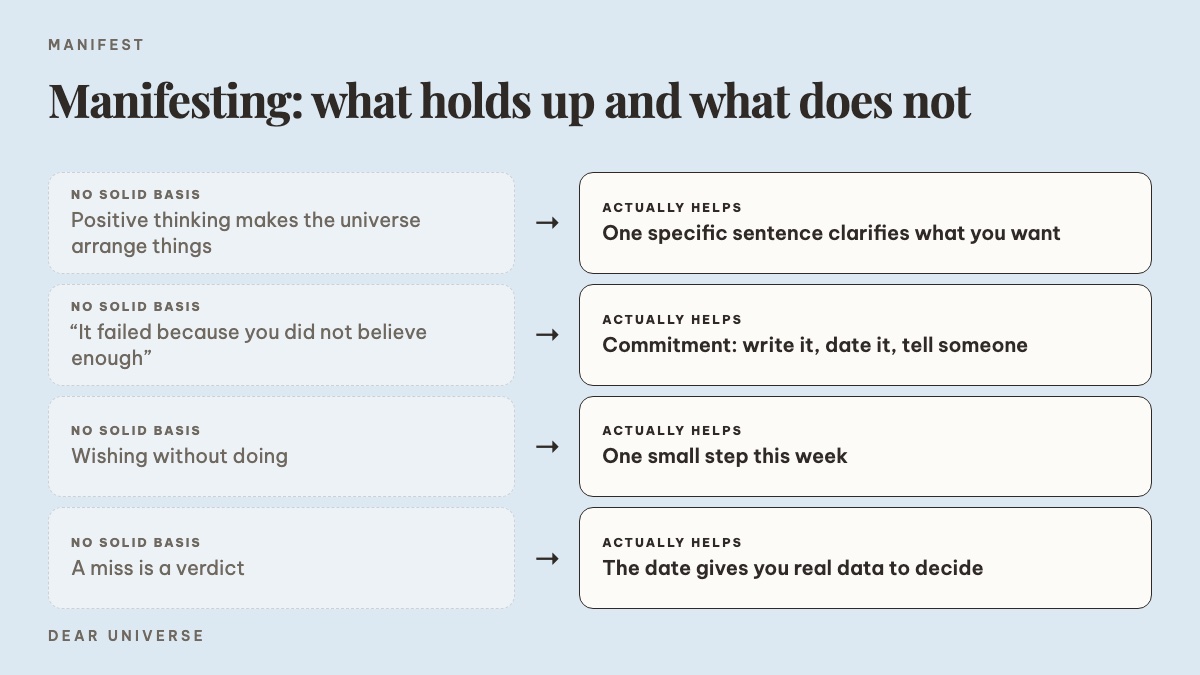 Manifesting: what has no basis versus what truly helps
What has no basis
There is no reliable evidence that positive thinking makes the universe arrange things so they happen. Sitting and wishing without doing anything changes nothing. Worse, it can make you feel as if you have already achieved part of it, and then you act less.
Another risky idea is "it did not work because you did not believe enough." It puts the blame on the person who is trying, and it is simply not true. Many things do not happen for lack of time, lack of opportunity, or plain luck, nothing to do with how much you believed.
What makes sense
The useful part of manifesting lies in very human things:
- It clarifies what you want. Forcing yourself to write one specific sentence means you have to know what you really want.
- It creates commitment. Writing it down, setting a date, telling someone: each makes it harder to brush aside.
- It shifts your attention. Once you know what you want, you start noticing related opportunities and small steps that were right there all along.
- It gives you a checkpoint. When the date arrives, you have real information to decide what to do next.
Psychologists have described similar ideas, such as Peter Gollwitzer's "if... then..." plans. Together they make the sensible part of manifesting easier to see.
So how do you use it with a clear head?
- Write what is within your reach. Focus on actions and results you can influence.
- Pair it with one small step. After writing, pick something you can do this week.
- Set a date and come back on that day to take an honest look.
- Allow the outcome to differ from the plan. If it did not happen, that is information, not a verdict.
And what about "the universe"?
On Dear Universe, "the universe" is a poetic way of saying a friend who reminds you: it messages you on the day, asks whether it happened, and listens to your story. It does not promise magic. Making it real is still up to you.
In short
Manifesting works when it becomes a plan with a date, and does not work when it is only wishing. If you want to try it that grounded way, send a manifest and arrange to meet your future self.
Keep reading
- 20 manifestation examples for study, work, money and health20 realistic manifest examples sorted by theme, with tips for adapting them: add your own numbers, set a date, keep it short and pick one that matters.
- What is a manifest? How to write one you will actually act onA manifest is not magic. It is one sentence about what you want, with a date. Learn how to write one that is specific, realistic and easy to keep for yourself.
- What is Dear Universe? Send a manifest, set a dateDear Universe lets you write one manifest, pick a date and get an email that day asking if it happened. How it works, what is public and why a date helps.